


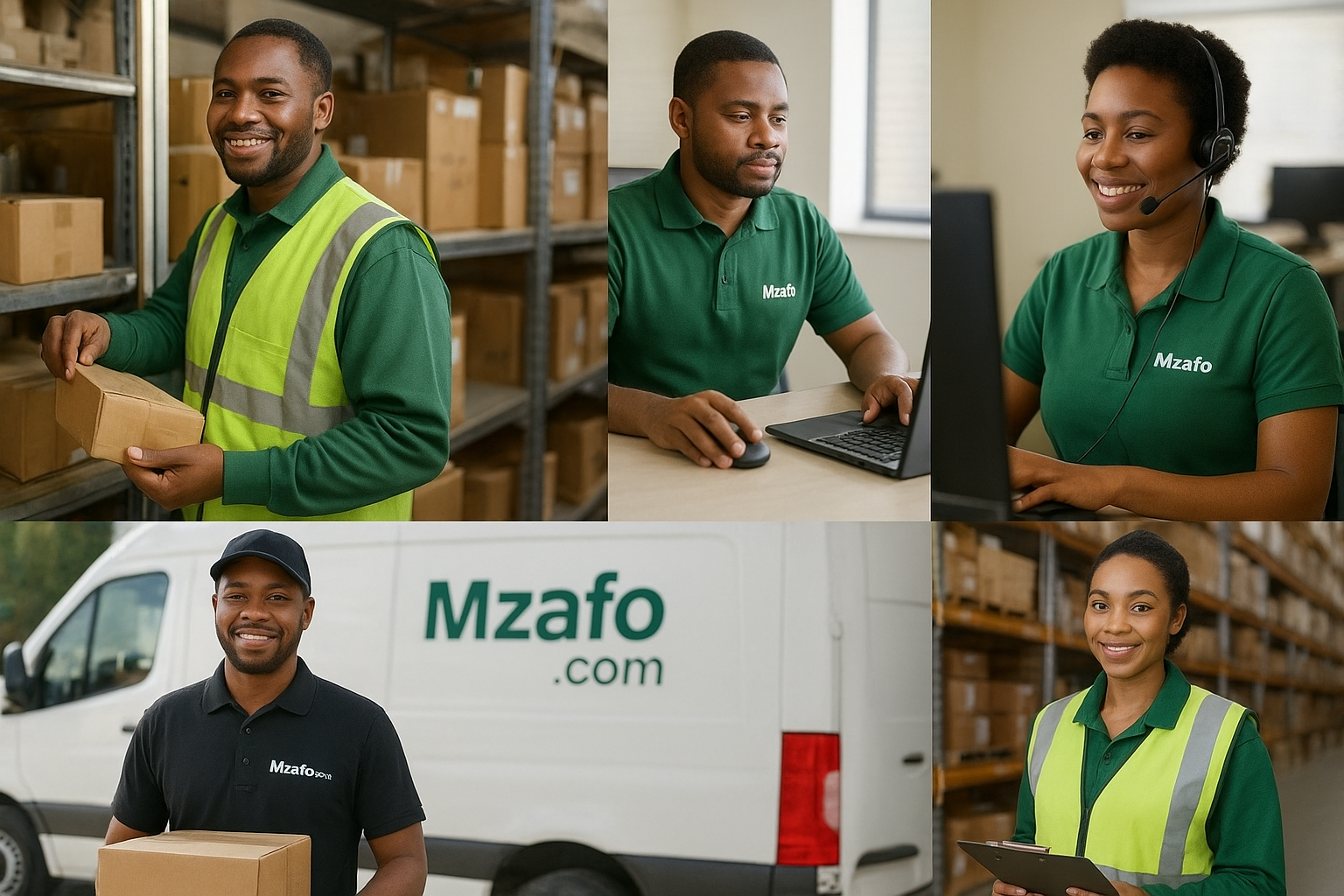
E-commerce is more than clicks and courier vans — it’s an engine for jobs, skills, and new businesses. If Mzafo.com (a South African online store) grows beyond an idea into a thriving platform, the ripple effects on employment across urban and rural South Africa could be huge. Below I map out — in detail — the kinds of roles that could be created directly and indirectly, the skills those roles require, how local communities could benefit, and practical steps Mzafo.com could take to maximize positive employment impact.
1. Quick framing: why this matters in South Africa
South Africa faces persistent unemployment and a skills mismatch; platforms that scale can become important job creators. An online retailer with strong local roots — prioritising local suppliers, decentralised fulfilment, and inclusive hiring — can create diverse types of work that range from entry-level to highly technical. Crucially, e-commerce scales: a single online store can support dozens of on-site jobs and hundreds — even thousands — of indirect roles across supply chains.
2. Direct employment opportunities within Mzafo.com
2.1 Operations & Warehousing
- Warehouse operatives / pickers & packers — receiving stock, picking customer orders, quality checks, packing for delivery. These are accessible entry-level roles with potential for shift work.
- Inventory controllers / stock analysts — monitoring stock levels, forecasting reorder points, managing returns. Requires basic Excel/ERP familiarity.
- Warehouse supervisors & managers — oversee teams, ensure KPIs (accuracy, throughput), safety compliance.
- Fulfilment centre planners — design efficient pick routes, optimize flow to reduce fulfillment time and costs.
- Quality assurance staff — checks on product condition, returned items processing, refurbishing for resale.
Why these matter: Warehousing provides stable, often unionised roles in urban areas and can be a first step into formal employment for many workers.
2.2 Last-mile delivery & Logistics
- Delivery drivers (employed) — company drivers for in-house fleet (vans, bikes). Could be full-time or part-time.
- Driver supervisors / routing planners — manage fleets, optimize routes, track delivery KPIs.
- Motorbike couriers (urban), bicycle couriers (dense areas) — flexible, lower-entry barrier jobs for gig-style work.
- Logistics coordinators & customer dispatch — match orders to drivers, manage exceptions (failed deliveries, address issues).
Opportunities for women and youth: Targeted training and safety measures can help increase female participation in delivery roles.
2.3 Customer Service & After-sales
- Contact centre agents — handling queries over phone, email, chat, social media; returns and refunds processing.
- Technical support / product specialists — for more complex product categories such as electronics or appliances.
- Community customer service ambassadors — local reps who handle in-person returns or help digitally-less literate customers.
Scalable roles: Customer service teams scale with customer base — making them reliable growth areas.
2.4 Technology & Product
- Frontend & backend developers — build and maintain website, mobile apps, APIs.
- DevOps & cloud engineers — ensure uptime, scale infrastructure, security.
- Data analysts & data engineers — customer analytics, recommendation engines, fraud detection.
- UX/UI designers & product managers — iterate on the shopping experience, conversion improvement.
- QA testers — automated and manual testing of features, payment flows.
High-value local jobs: These roles pay well, attract talent, and anchor a tech ecosystem around the platform.
2.5 Marketing, Sales & Merchandising
- Category managers & merchandisers — select products, negotiate vendor agreements, manage pricing.
- Digital marketers — SEO, SEM, social media, content marketing, influencer partnerships.
- Partnership & B2B sales teams — onboarding suppliers, co-marketing, white-label partnerships.
- Creative roles — photographers, product stylists, copywriters, video editors for product pages.
SME engagement: Marketing roles can expand opportunities for local creative freelancers and studios.
2.6 Finance, Legal & Admin
- Accountants & financial analysts — bookkeeping, cashflow management, reporting.
- Payments & reconciliation specialists — manage multi-channel payments, fraud checks, chargebacks.
- Compliance & legal — consumer protection, privacy, vendor contracts.
- HR & learning & development — hiring, payroll, staff upskilling programs.
3. Indirect and ripple employment (supply chain & ecosystem)
3.1 Local manufacturers & suppliers
If Mzafo.com prioritises South African suppliers, it can drive demand for:
- Clothing manufacturers, artisan producers, FMCG packagers, electronics assemblers.
- Job types: factory floor workers, machine operators, quality controllers, export managers.
3.2 Packaging, printing & labelling
- Local packaging companies — demand for e-commerce-grade boxes, sustainable packaging.
- Design & print houses — labels, inserts, marketing collateral.
3.3 Logistics partners & freight
- Regional haulage operators, 3PLs (third-party logistics), and cross-dock facilities expand as order volumes grow.
- Port and customs agents if cross-border trade increases.
3.4 Payment & fintech services
- Payment gateway integration specialists, mobile money agents, reconciliation service providers.
- Growth of fintech partnerships creates jobs in software, compliance and customer support.
3.5 Gig & micro-entrepreneurship
- Owner-driver couriers, pop-up pick-up points managed by local shopkeepers, and drop-shipping micro-businesses.
- Marketplaces enable entrepreneurs to test products without large upfront investments.
Net effect: A successful e-commerce platform multiplies employment across upstream (production) and downstream (delivery & retail) segments.
4. New and emerging roles enabled by scale & tech
4.1 Data science & personalization teams
- Roles focused on demand forecasting, churn modelling, dynamic pricing and personalization engines.
4.2 Sustainability & circular economy roles
- Reverse logistics managers for returns and refurbishment.
- Circular economy analysts to design resale, repair, and recycling programs.
- Sustainability officers to track emissions, packaging waste, supplier audits.
4.3 Automation & robotics
- As warehouses scale, jobs in robot maintenance, automation engineers, and systems integrators will appear. These are higher-skilled but also create training pathways.
4.4 Community & Field Growth Roles
- Local business development reps who help small vendors onboard.
- Field trainers teaching SMEs how to list products, manage inventory, and understand e-commerce metrics.
5. Skills, training & career pathways
To translate opportunity into lasting employment, skills development is essential.
5.1 Entry-level to skilled progression
- Offer on-the-job training (warehouse safety, inventory systems).
- Provide digital literacy courses for vendors and local customer service reps.
- Create apprenticeships and internships for logistics, marketing, and data roles.
5.2 Partnerships with TVET colleges & NGOs
- Work with technical colleges for short-course certifications (forklift operation, basic IT, digital marketing).
- Offer work readiness programs and interview coaching.
5.3 Upskilling for automation
- Transition pathways: pickers → supervisors → warehouse data analysts.
- Re-training programs for workers affected by automation.
6. Entrepreneurship & small business acceleration
Mzafo.com can be an engine for local entrepreneurship.
- Market access: Small producers and artisans gain national exposure without expensive retail.
- Micro-fulfilment: Local fulfilment hubs help small sellers store products and access faster delivery.
- Vendor enablement services: Photography, listing assistance, pricing workshops turn informal makers into scalable businesses.
- Financing & credit scoring: With transaction histories, Mzafo.com can partner with lenders to offer working capital — enabling growth and hiring by SMEs.
7. Geographic equity: urban and rural job creation
E-commerce need not be concentrated only in metros.
- Rural collections & aggregation points: Local hubs where goods are pooled for dispatch — creates coordinator and driver jobs.
- Satellite fulfilment centres in secondary cities reduce delivery times and create jobs locally.
- Local pickup points (spaza shops, community centres) generate commission-style income for owners.
8. Inclusion: creating accessible opportunities
Intentional policies can make jobs inclusive:
- Women-friendly logistics: safe shifts, female locker rooms, gender-sensitive hiring.
- Youth programs: internships and apprenticeships targeted at unemployed youth.
- Disability inclusion: adapted roles in quality control, packaging, and remote customer service.
- Multilingual support: customer service in local languages to expand reach and hire locally.
9. Green jobs & sustainability-driven employment
E-commerce can create environmentally conscious jobs:
- Sustainable packaging production — jobs in manufacturing compostable or recycled packaging.
- Reverse logistics & refurbishment centres — technicians, quality assessors, resale coordinators.
- Carbon tracking & reporting roles — analysts to measure and reduce emissions across fulfilment and transport.
10. Challenges and risks to manage
Growth creates opportunities — but only if risks are managed.
- Precarious gig work: Avoid dependence on exploitative gig models; offer benefits where possible.
- Skill mismatch: Invest in continuous training to prevent a gap between available jobs and worker skills.
- Vendor overload: Rapid onboarding without quality control can damage brand trust and stall growth.
- Infrastructure gaps: Electricity, internet, and roads in some areas constrain logistics; partnerships and local solutions are vital.
11. Practical steps Mzafo.com can take to maximise employment impact
- Local-first procurement policy — set targets for local supplier sourcing and publish progress.
- Create a vendor enablement programme — photography, listing help, pricing workshops, basic bookkeeping.
- Launch a logistics academy — certificate courses for drivers, warehouse staff, and supervisors.
- Offer guaranteed minimum hours for delivery staff — reduce precarity and increase income stability.
- Set up micro-fulfilment hubs in secondary cities and townships to decentralize jobs.
- Partner with TVETs and NGOs for apprenticeships and targeted youth hiring.
- Design a supplier finance product in partnership with fintechs to help SMEs scale inventory and hiring.
- Measure and publish social impact metrics (jobs created, women employed, rural hires) to attract impact investors and partners.
12. Case examples of potential job pathways (simple scenarios)
- Thandi from Soweto: starts as a packer at Mzafo’s local fulfilment hub → completes a forklift operator course → promoted to shift supervisor.
- Sipho in Polokwane: sells handmade homeware on Mzafo, uses vendor onboarding help to improve listings, obtains small loan via Mzafo partner → hires two local assistants → becomes a regional supplier.
- Aisha in Cape Town: works as a remote customer service agent in isiXhosa and English; after 18 months becomes a team lead managing a multilingual team.
13. The macro effect: economy and resilience
When e-commerce platforms scale thoughtfully, they help:
- Diversify local economies, reducing dependence on single industries.
- Increase formal employment by moving informal sellers into formal supply chains.
- Stimulate downstream industries (packaging, logistics, fintech).
- Build resilience: local sourcing shortens supply chains and reduces vulnerability to global shocks.
14. Conclusion — Mzafo.com as a job creator and ecosystem builder
Mzafo.com has the potential to be much more than a shopping site: with deliberate strategy it can be a platform for job creation, entrepreneurship, and skill development across South Africa. By focusing on local sourcing, inclusive hiring, training, and sustainable logistics, Mzafo.com can create a broad ladder of opportunity — from entry-level warehouse roles to high-value tech jobs — while strengthening local suppliers and communities.